
What happens when NIH funding cuts aren’t evenly distributed?
The answer isn’t neutral.
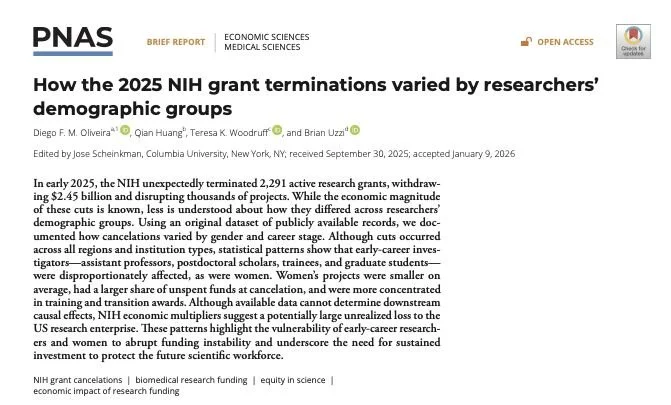
A new paper in PNAS reports that the 2025 NIH grant terminations disproportionately impacted female and early-career investigators.
Notably absent from this analysis is any examination of race and ethnicity—and that is a gap that urgently needs to be filled.
This isn’t just a funding story—it’s about who stays, who advances, and who is pushed out of science.
When funding disruptions are not evenly distributed, neither are the downstream consequences:
– lost research momentum
– gaps in productivity
– disrupted teams and collaborations
– and ultimately, altered career trajectories
So, the real question isn’t just what happened.
It’s: What are institutional leaders going to do about it?
As institutions respond, there are some urgent questions that need to be addressed explicitly—not quietly, not retroactively:
How are decisions about bridge funding being made—and with what equity safeguards?
Who will have contracts renewed, and who won’t—and how will those decisions account for structurally uneven impact?
How will this period be contextualized when faculty come up for tenure and promotion?
What mechanisms will ensure that short-term funding disruptions don’t translate into long-term career disadvantage for groups already underrepresented or at risk?
If we don’t address these questions head-on, we risk reinforcing the very disparities we say we are committed to reducing.
Moments like this don’t just test institutional resilience—they test institutional values.
And they offer a choice: to treat this as an isolated disruption, or as a call to design systems that are more equitable, transparent, and accountable moving forward.
