
Stop Giving Answers. Start Asking Better Questions.
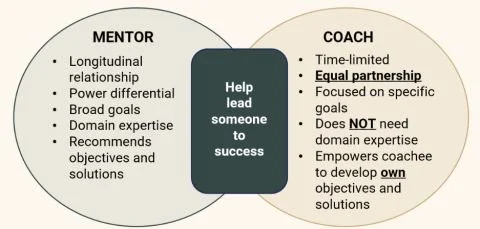
A mentor tells you what they would have done. Coaching helps you figure out what you are going to do. Academic medicine runs almost entirely on the first. The mentors I work with get noticeably better at it once they learn the second.
Mentorship is genuinely valuable, and I am not arguing against it. Knowledge transfer is how most of us learned to structure an aim, pick a journal, and read a summary statement without spiraling. That knowledge is hard-won and worth passing down.
But it has a built-in limit: a mentor is advising from their own lived experience. And that experience can look very different from their mentee's — generationally, by gender, and especially for mentees from backgrounds underrepresented in science. "Here's what worked for me" is only useful to the degree that what worked for them is actually available to the mentee.
Coaching starts from a different premise. The coachee is the driver of change. The coachee is treated as whole, resourceful, and the expert on themselves. The coach's job is not to supply answers. It is to ask empowering questions rooted in genuine curiosity, so the coachee gains clarity, expands what feels possible, and takes action toward their own goals.
People hear "coaching" and assume it is the soft option. Adult learning and intentional change theory say otherwise: people are far more likely to act on, and stay accountable to, ideas they generated themselves than solutions handed to them by someone else. So telling someone what to do, which feels like the efficient choice, is usually the one that goes nowhere.
Here's the part I most want those responsible for mentoring to hear: this is not mentoring versus coaching. Coaching skills make you a dramatically better mentor.
Ask before you advise. Get curious about the constraints and values your mentee is actually working within before you hand over your playbook. Hold your expertise until it has somewhere to land, then offer it, clearly labeled as one option rather than THE path. Mentors who can coach don't give less guidance. They give guidance their mentees can use.
I train faculty in these skills, and the thing that surprises people most is how learnable they are. Asking before advising is not a personality trait. It is a practice, and it is probably the highest-leverage thing most of us could change about how we mentor.
