
I was honored to recently deliver Grand Rounds for the Department of Internal Medicine at the University of New Mexico.
My talk: "Creating a Culture of Coaching in Academic Medicine — Peer coaching as a scalable faculty development model."
Coaching works. The evidence for coaching in academic medicine keeps growing. The real question for institutions is how to make it reach everyone who needs it, and keep it going.
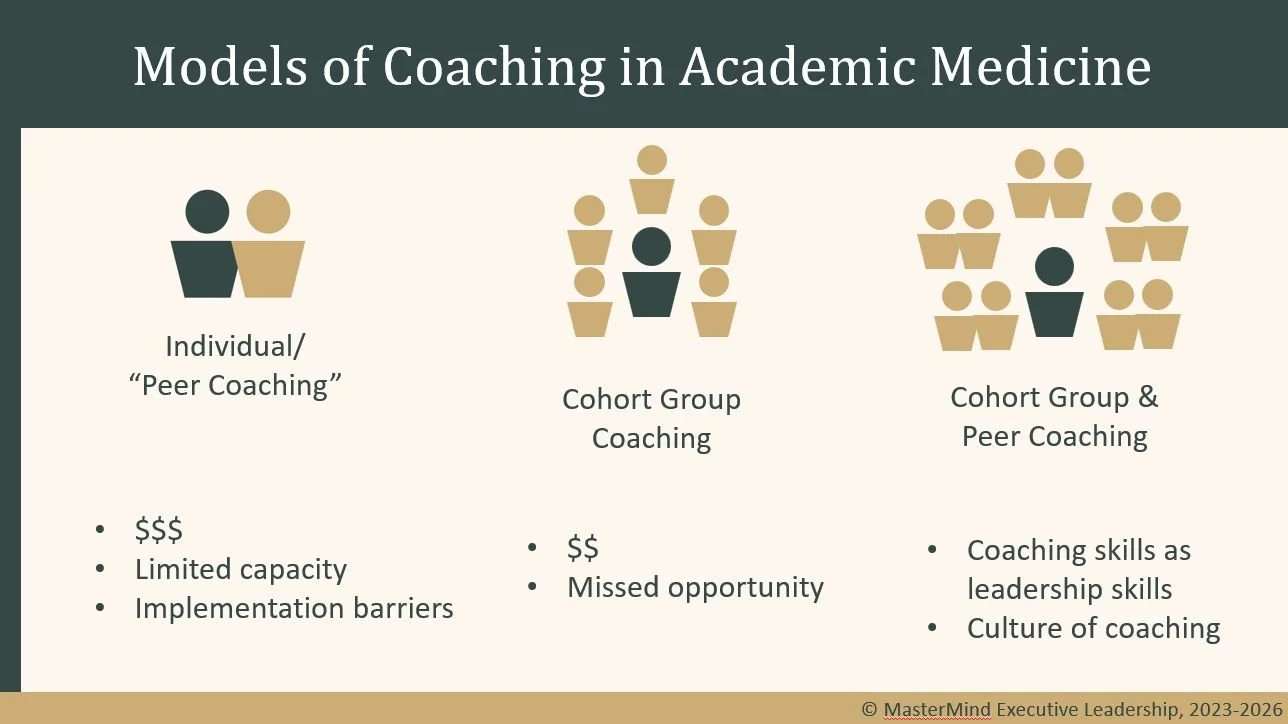
This slide sums up three models:
1️⃣ Individual coaching: Powerful, but $$$. Capacity is limited, and getting it implemented in a sustainable way is hard.
2️⃣ Cohort group coaching: More affordable and wider reach ($$). But it's a critical missed opportunity if faculty only receive coaching without learning to use those skills themselves.
3️⃣ Cohort group + peer coaching: Faculty experience the validation, power, and belonging of group coaching and build their own coaching skills to use with each other. Coaching skills become highly transferable relational leadership skills, and over time a true culture of coaching takes root.
That third model is where I see the biggest return. The skills don't leave when the program ends. They show up in mentoring meetings, lab meetings, committee work, and hallway conversations, long after the last session.
Thank you to Larissa Myaskovsky, PhD, FAST for the invitation, and to everyone at UNM who joined, asked thoughtful questions, and stayed to keep the conversation going.
If your department or institution is thinking about scalable faculty development through coaching, I'd love to connect.
Building a Culture of Coaching That Lasts Beyond the Program

Previous
Previous
You Don't Need More Time. You Need a Different Approach.
Next
Next